Pages

Tuesday, September 18, 2012

Where I'm From


I am from the roaring waves and soft grass,

From peaceful nights and noisy days,

The creaking of swings and the splashing of water,

From the chirping of birds and the buzzing of cicadas,

And hot summers and cold winters.


I am from medals and trophies of pools,

From the gallops and pounding of hooves,

From choir and orchestras,

And from the scent of wood in newly bought books.


I am from "told you so", "speak louder", and "one more minute!"

From "you can do better," and "hey, that's mine!"

I am from loud shouts to soft whispers.


I am from bubble teas and milkshakes,

From barbeque to gumbo, 

Donuts and baguettes,

And from sneaking bits of chocolate,

In the middle of the night.


I am from the old family album,

that lives in my attic.

From the dusty picture frames,

that sits upon the walls.

I am from old and new scrapbooks,

and the things that go bump in the night.


Sunday, February 19, 2012

Propaganda

"Behind the Enemy Powers: The Jews"

Propaganda is misleading or biased information used to promote a political cause or view to the general public. The poster shown above is an example of propaganda, created in 1940 by Hamil for all of Germany to view, warning them about how Jews were the cause of their demise and suffering: "Hinter den Feindmãchten: der Jude" Behind the Enemy Powers: the Jews.

In this image, there are three flags: the British, American, and Soviet flags, with a man standing behind them with a Star of David on a chain along his chest. The stereotyped Jew (large, rich-looking) is standing as a large figure behind the three flags. The Jew's expression is intimidating, as if he was planning something, and does not maintain eye contact with the viewers.


The creator of the poster, Hamil, was trying to give off the feeling of conspiracy. The Jew, dressed in a black suit, hat and drawn as a rather fat man, gives off the impression as a wealthy entrepreneur. The Jew while standing behind the British, American, and Soviet flags with his left eye at the corner of his eye, makes it look as if the Jew is planning something. At the same time, this caricature shows a Jew not only planning something, but manipulating world affairs. This makes the viewers assume that the Jews works behind the scene to control the Allied Powers to go against Germany.

This image of a Jew standing behind the Allied Power flags, could have possibly caused the Germans to become wary of their Jewish neighbor, and soon, distrust them.The way the Jew had been portrayed in the poster was what most Germans already thought of them after so many other propagandas: Rich and evil. Placing the Jew behind the Allied Powers, the cause of Germany's demise, furthered the Germans’ anger and belief that the Jews were the main cause of why they lost World War I. As a result, men and women would have kept their family away from Jews, and influence children from young ages to harbour a distrust for Jews.


This image of the poster utilizes both lies and misleading messages to create a negative impact on the impression on Jews. Utilizing the German's kindled fear for Jews and the hatred for the Allied Powers, along with the belief that Jews were the cause of the fall of the Germans' Fatherland, this poster effectively uses the belief an emotions already there and furthers it by hinting that the Jews were conspiring with the Allied Powers.


Wednesday, February 8, 2012

The Boy in the Striped Pyjamas

"Stand up for what you believe in, even if it means standing alone."
- Unknown


The Boy in the Striped Pyjamas by John Boyne is about two boys, Bruno and Shmuel; one who is Jew, while the other is German. They lived in the time of the holocaust, which prevented them from leading normal friendship, but they are able to become friends despite all the differences. However, even though the story is a tale about two innocent, young, and naive boys, it touched another topic outside of the two boys' lives. What especially stood out in his tale was how no one ever stood up against what was happening. Even though the adults knew what was happening, none of them ever stood up for what they thought was right.


The main reason why no one ever stood up against the Nazis for the Jews was because they were afraid. They were afraid to go against Hitler's orders, and those who supported him strongly, because they knew that if they stood up, they could just as easily be labeled a traitor, and be thrown into concentration camps like the Jews, or get killed. And while they were treating Jews with injustice, Hitler had given the citizens of Germany hope, telling them that the start of all trouble lied with the Jews, that they were the fault of everything that had happened to them after the Treaty of Versailles.

When should an individual take a stand against what he/she believes to be an injustice? I believe that there is no right time, and all that matters is that you have the courage to take a stand for what you believe in. If you don't take a stand against what you believe to be an injustice, nothing will ever change, if not get worse. In The Boy in Striped Pyjamas the movie, the mother found out from Lieutenant Kotler that they were putting Jews in gas chambers, then after their death, they cart them out to cremate the bodies. While she was horrified and disgusted by what she found out, she did absolutely nothing to try to stop it. The mother had ignored it, and tried to live her life as if nothing had happened. While she believed that the Jews were being treated with injustice, she did not take a stand against authority, and try to right a wrong.

Questioning or challenging the social order can be both a good thing or a bad thing. While you may be the only one with enough courage to question what the authority is doing, it could be enough to start a movement, and bring justice to what or who had been treated badly. However, the consequences weigh heavily, as you could be labeled traitor, or alienated by society because of what you said or what you believed in, like how the Jews were isolated from public because of their religion.


Take a Stand

Wednesday, February 1, 2012

Treaty of Versailles

The Treaty of Versailles: Just or Unjust?

"In the place where, in the glorious year of 1871, the German Empire in all its glory had its origin, today German honor is being carried to its grave. Do not forget it! The German people will, with unceasing labor, press forward to reconquer the place among the nations to which it is entitled. Then will come vengeance for the shame of 1919.”
- German newspaper, Deutsche Zeitung


The Treaty of Versailles was an agreement that was discussed and negotiated for months, and finally signed in Paris, France in 1919 by the Allied Powers and the Germans. Originally, the treaty between the Allied Powers and Germany was to be based on the "Fourteen Points" President Wilson of America brought up, but the French representative Georges Clemenceau, who backed the general French views with one simple belief: that Germany should be brought down so it could no longer do any harm; and English representative David Lloyd George, who supported the British want of revenge in public, but privately thought that Germany shouldn't be treated with such harsh rules.

When the German representatives arrived in Paris, France, they had been expecting to sign the points President Wilson had made. However, they had instead been greeted with a much harsher treaty with no way out. If they backed, the Allied Powers would invade their land.

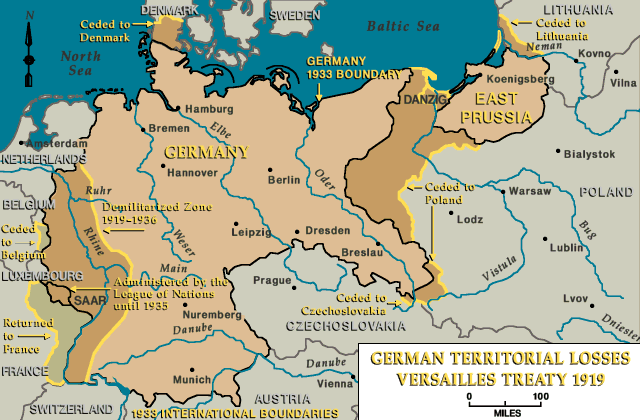
The treaty included the rules such as the military forces of Germany shall not exceed 100,000 men, and that they would pay and accept responsibility of all damage caused to the Allied Powers, to name a few. In the end, Germany had to pay a total of $33 billion. Out of the 440 clauses mentioned in the treaty, 414 of them dealt with the punishment of Germany.

While they complied to the demands, they swore vengeance, as written by a German newspaper, Deutsche Zeitung:


"In the place where, in the glorious year of 1871, the German Empire in all its glory had its origin, today German honor is being carried to its grave. Do not forget it! The German people will, with unceasing labor, press forward to reconquer the place among the nations to which it is entitled. Then will come vengeance for the shame of 1919.”


Was the Treaty of Versailles just or unjust? While some people might think that the treaty was just, and that the Germans inflicted much harsher rules upon Russia, others disagree. While the Allied Powers and other smaller nations might have wanted justice and compensation for the damage World War I caused, making Germany loose land, pay $33 billion, and become in debt by themselves was not the way to go. Germany and her people took full blame of the war.


The Allied Powers may have started the League of Nations (excluding America, Germany, and USSR), but the Europeans and French wanted what was best for themselves, and not for the world itself. This reflected in the 440 clauses mentioned in the Treaty of Versailles.


The Treaty of Versailles caused many Germans to loose their money and their jobs. The economy of Germany fell, making the life of a German harsh and cruel. The Germans became desperate and angry. Not only had they lost land, but had also lost their dignity and power. They wanted revenge.


Later, Adolf Hitler rose up to power, promising the disgraced and desperate Germans power and wealth. He used the treaty as a starting point, and told the Germans that he would restore national pride and world recognition.


In the eyes of outraged citizens in countries abroad, the Treaty of Versailles may have been fair. Instead, it was much too harsh, and the treaty, instead of solving problems as it had been intended, created more.


Lost German Lands

Thursday, January 26, 2012

No Man Is An Island


"No man is an island entire of itself; every man
is a piece of the continent, a part of the main;
if a clod be washed away by the sea, Europe
is the less, as well as if a promontory were, as
well as any manner of thy friends or of thine
own were; any man's death diminishes me,
because I am involved in mankind.
And therefore never send to know for whom
the bell tolls; it tolls for thee."

These words by John Donne from the 1624 Meditation 17, from Devotions Upon Emergent Occasions 


How do these texts explore similar themes?


The three texts, Meditation 17 by John Donne, The Island by Armin Greder, and the other, Mankind Is No Island, by Jason van Gederen, all explore the theme of connection and isolation between people. No one can live on earth without affecting another as told by John Donne and shown by van Gederen, and is shown in The Island by Greder. A stranger appeared on an island, and at first, the villagers took him in, but because of his strangeness, he was isolated away from the villagers, put in a goat pen. But fear slowly grew upon them until, finally, they pushed him back out into the sea. Although the stranger had done absolutely nothing, he affected the villagers in a huge way. In the visual text by van Gederen, it's shown that the homeless are ignored by others because they lived on the streets, and looked ragged. The fortunate people walk past them, and it's like looking at a whole other world, where the poor are isolated from the fortunate, and while it doesn't seem like they affect them, the poor people do because it is a reflection on the people who were lucky.


How do the texts provide insights into prejudice and "otherness"?

The texts provides insights into prejudice and "otherness", especially in The Island, where Greder shows the isolation of one stranger/foreigner, and how since he had arrived different, the villagers had not wanted him on his island nor had they wanted to take him in because judged him before they actually came to knew him. It is also shown in Mankind Is No Island, when we ignore the homeless on the streets because they are poor, and we don't know them. People judge others before they get to actually know them because they are different, they aren't like them.


Why do people make distinctions between "us" and "them"?

I think that people make distinctions between "us" and "them" because they are afraid of what is different and what they do not know or understand. If they meet another person who looks/acts different, they become scared because the person could be dangerous. Another reason is that people make distinctions between "us" and "them" is because they are afraid of people being more powerful, and that if they make an "us", they might be able to overcome the "them".


Thursday, January 19, 2012

Nature at Work

Over winter break, Mr. Peavy gave the class a long-term project, which was for us to get out, experience, and record Nature. I decided to do Task B, which was to choose 5 tasks from this site.

Task 1: Start a rock collection


In New Zealand, I collected rocks from various places, which includes sedimentary rocks such as shales and sandstone, and river pebbles.


Task 2: Scientific name of a plant


Task 3: Find a streetlight or backyard light and watch for insects who flutter into it


When I saw outside in the night near a streetlight, I noticed that there was a bunch of insects flying around it. Now, this wasn't new, but I never understood why they flew around the light. So, I searched up why.

A favored hypothesis is that the insect's brains are programmed to keep a bright light at a certain angle on its eye. Before humans came along and invented artificial light, the only way to fly by was the moon. And since the moon is 280,000 miles away, the insects were able to fly in a relatively straight line. The system of travel for insects doesn't work nowadays because the artificial lights (streetlights, lamps, light-bulbs, etc) shine in all direction (or a full circle), so the insects end up traveling in an endless circle around the light.

Task 4: Learn to Identify Poison Ivy


Poison ivies have three divided leaves, its center leaf is on a longer stalk, and there is white berries along the stem. Sometimes, it appears as a low, upright shrub, while other times, it is a vine that can climb up to sixty feet high.
Poison ivies usually reside in flood plains and upland forests, along roads, railroads, streams and fences.

Task 5: Blossom Arrangement


Foxgloves: The foxglove flower is a corymb because its flowers come out directly from the stem.


Coriander: Coriander flowers have an umbel arrangement, which means that it's flowers come out from the top of the stem into tiny different ones.

Sunday, November 20, 2011

Profile JJ


Last year, Mr. Whiting came into the classroom to help us learn our learning profiles. Then, it was Profile JJ. Now, it is still Profile JJ. To figure out my learning profile and confirm whether or not it has changed, we tested our eyes, hands, ears, and feet to determine what our learning profile would be. Even a switch of whether you use your left or right ear can be a big difference. This year, both of my hands reached out to catch whatever was falling, so after thinking a while upon the situation, we decided that my right hand would be dominant.


I think I learn best when there's nothing to distract me from what I'm doing. I sometimes spend hours on my homework when it should only take me from 15-30 minutes. Being alone in the room would also benefit me, because when certain people come into the same room as me, I randomly remember something else I have to do, and whatever I was doing originally gets left alone. On the paper I received, it says that sitting on the right side several rows back will help me learn better because there, I can hear easily.


The strategies that would help me learn better is learning how to prioritize. If I could learn how to do that, my school life and home life would be easier. Another strategy is for me to analyze decisions and go through logical reasoning processes. That might be a challenge for me-I'm the kind of person who doesn't think through everything before doing it. And time management, definitely need to work on that. I do other stuff when I'm only supposed to be concentrating on my homework, so it takes longer.


I would like my teachers to know that I don't like thinking logically, and I don't like it when we have to order/number things. I find it useless and boring to do. I like to write or doodle during class if I have a paper in front of me. If the teacher talks for more than five minutes at a time, I tend to zone out and not pay attention to what the teacher is teaching us. I also get distracted easily during class.